



Beyond the barracks, the forts and the battlefields, a journey through the military histories that shaped a coast
What remains of a war after the soldiers have gone? Sometimes, a fort facing the sea. Sometimes, a wall swallowed by vegetation, a public ground in the middle of a town, or a mosque whose name remembers the men who once prayed there. Elsewhere, the memory survives in a boat cutting through backwaters, the measured movements of a martial art, or a king who returns to life beneath the lights of a village stage.
- Beyond the barracks, the forts and the battlefields, a journey through the military histories that shaped a coast
- Before the barracks, there were kingdoms
- Calicut: where commerce went to war
- Cochin: power along the waterways
- Travancore: building an army, defending a kingdom
- A defensive line written into the land
- The backwaters, the boats and the cost of resistance
- When warriors become memory
- Kannur: the coast changes hands
- What remains after the army?
In Keralam, the military past is rarely confined to the battlefield. It spills into the ordinary geography of everyday life: the streets we cross, the waterways we travel, the neighbourhoods that grew around camps and the places where communities continued to live long after political power changed hands.
Begin in Palayam, in the heart of Thiruvananthapuram. Traffic moves between a mosque, a temple and a cathedral. The name Palayam recalls a military camp, but the neighbourhood tells a story larger than the presence of soldiers. Armies needed grain and water, smiths and boatmen, places of worship and households that supplied the many things a marching force could not carry with it. Around military establishments, life went on. Sometimes, it settled permanently.
That is where this journey begins: not with a catalogue of weapons, but with the landscapes that war left behind.
Before the barracks, there were kingdoms
There was never one army, one martial tradition or one continuous political identity stretching across the region we now call Keralam. Travancore, Cochin and the Zamorin’s Calicut were powerful centres, but they existed alongside a shifting constellation of smaller kingdoms and chiefly territories. Kolathunad, Valluvanad, Kadathanad, the northern Kottayam kingdom associated with Pazhassi Raja, Arakkal, Kayamkulam, Chempakasherry, Thekkumkur and Vadakkumkur each occupied their own place in a changing political order.
Their boundaries shifted with conquest, succession, diplomacy and war. Alliances were rarely permanent. The coast, fertile agricultural land, river crossings, ports and the revenue they generated were all worth defending.
Before the regimented parade ground became familiar, military power often rested on territorial chiefs, local authorities and networks of armed retainers. Kalaris provided spaces for bodily discipline and martial training, though their organisation and practices varied across places and periods. Access to land, caste and inherited status shaped who commanded and who served. The romantic image of the warrior must not obscure the social order that made such service possible.
The martial past also extends beyond royal Nair households. Muslim sailors and naval commanders, Christian soldiers, and Kurichiya fighters in the forests of Wayanad belong to this history. Northern ballads remember figures such as Aromal Chekavar and Unniyarcha, but the world of ballad and performance is not interchangeable with the documentary record of an army.
To understand the region’s military heritage is to hold these different kinds of memory together without mistaking one for the other.
Calicut: where commerce went to war
On the banks of the Bharathapuzha at Thirunavaya, the story turns towards Mamankam, the great gathering that brought together trade, ceremony and political authority. The Zamorin’s assumption of its guardianship from Valluvanad became part of a larger struggle over sovereignty. Chaver warriors challenged the Zamorin at enormous personal cost, entering a history remembered through accounts, memorials and retellings.
The river is still there, carrying on with its own business. The landscape asks a quieter question than the legends do: what lay behind the celebrated acts of sacrifice? Political rivalry involved rulers and warriors, but it also touched households, dependants and communities whose lives were shaped by the ambitions of those who held power.
Further north, the coast takes over the narrative. Near Payyoli, the Kunjali Marakkar memorial recalls successive Muslim naval commanders who served the Zamorin during the sixteenth-century conflict with the Portuguese. Kunjali was a title associated with a succession of commanders, not simply the name of one solitary hero.
The struggle was about more than military supremacy. Pepper and other goods travelled across the Arabian Sea, linking Malabar to distant markets. Whoever controlled shipping, ports and access to the coast could influence commerce as well as politics. Small, manoeuvrable craft and knowledge of coastal waters gave the Marakkars advantages against a heavily armed maritime opponent.
Yet this was not a straightforward tale of a united coast confronting foreign invaders. The Zamorin eventually joined the Portuguese against Kunjali IV, who was captured and executed in Goa in 1600. Alliances that had once sustained a naval resistance unravelled under competing political interests.
The rupture complicates the familiar hero story. It also makes it more revealing. Power was negotiated locally as well as imposed from overseas, and the people who resisted one authority could find themselves at odds with former allies.
In Kozhikode itself, the military past appears in a less dramatic form. Near Palayam market stands Pattalapalli, a name commonly understood as the soldiers’ mosque. The Census of India’s Kozhikode District Census Handbook records its association with cantonment soldiers, while the city’s master-planning account attributes it to Mysorean troops. The precise origins deserve further research.
The building’s name survives more securely than a single agreed account of its foundation. That, too, is a kind of history: one in which the clues remain, even when the complete story has not yet been recovered.
Cochin: power along the waterways
At Chendamangalam, Paliam Palace opens another door into the politics of war. The Paliyath Achans, holders of a hereditary family title, served as influential ministers and military leaders of Cochin. Their world was shaped by landed power, river routes, negotiations and changing relationships with European powers, including the Dutch.
The palace is not simply a royal residence in miniature. It represents a political order in which influence could be exercised from a powerful household as well as from a throne. Local rulers and ministers made alliances to protect their interests; those alliances could change as circumstances changed.
In 1808–09, Paliyath Achan joined Travancore’s Velu Thampi Dalawa in resisting the growing influence of the British East India Company. Waterways became approaches for armed men moving towards Cochin, and the attack on the British Resident failed.
Today, a ferry journey through the backwaters offers a way to understand the geography of that conflict. Narrow channels, landing places and the connections between inland settlements and the harbour reveal why water mattered to movement and military strategy. It would be misleading, however, to present an ordinary boat trip as the exact route of a historical expedition.
In this part of the coast, rivers and backwaters were not scenery behind the action. They were part of the action itself.
Travancore: building an army, defending a kingdom
Southwards, Travancore’s history brings us to the making of a more centralised state army. Under Marthanda Varma, the kingdom expanded by absorbing smaller southern powers. What later accounts might describe as consolidation was, for those defeated, also conquest.
But Travancore’s military history did not begin with Marthanda Varma, nor was political authority always held by a man. In the seventeenth century, Umayamma Rani ruled Venad through a period of political and military uncertainty. Accounts of her reign connect her with an incursion into southern Venad and the challenges of defending her authority. The details of these episodes require careful verification, but her place in the region’s political history is a reminder that warfare demanded more than command on a battlefield. It also required decisions about alliances, territory and the survival of a kingdom.
At Colachel in 1741, Travancore defeated the Dutch East India Company. Among the captured Dutch officers was Eustachius De Lannoy, who subsequently entered Travancore’s service. He helped develop the kingdom’s military capabilities through European methods of training and fortification.
His story unsettles the easy division between foreign enemy and local defender. A man captured in one war could become an officer serving the ruler who defeated him. Yet Travancore’s military success cannot be credited to one European officer alone. It also depended on the ruler, existing forces, local resources and the political circumstances of the time.
At Udayagiri, near Padmanabhapuram, De Lannoy’s tomb places that complicated history within a physical landscape. The journey also crosses a modern political boundary: the former Travancore heartland and these historic sites now lie in Tamil Nadu. The map of the past does not always conform to the map in a traveller’s hand.
Back in Thiruvananthapuram, the Nair Pattalam belongs to the history of Travancore’s evolving military organisation. The force underwent successive changes, eventually becoming associated with the name Nair Brigade. Its story includes firearms, drill and changing institutional relationships, not merely the swordsmanship of an earlier age.
At Palayam, a building recorded as having been constructed for the brigade in 1868 later served as a military hospital and the City Police Commissioner’s office. Today, it houses the Historic Museum of the Kerala Legislative Assembly. The change in use is significant: a building associated with military organisation has become part of the civic and political life of the capital.
Nearby, Palayam’s mosque traditions preserve another connection with military history. A heritage inventory traces the beginnings of a small soldiers’ place of prayer to 1813, though the present structures reflect later rebuilding. The mosque, the former brigade building and the surrounding places of worship invite us to consider how institutions and neighbourhoods outlast the arrangements that first brought people together.
They also remind us how much remains to be learned. Family histories, inscriptions, records of repairs and local testimony may reveal more about the people who lived around the camp. Their identities and experiences should not be inferred from a building’s name alone.
A defensive line written into the land
In central Keralam, Nedumkotta, or the Travancore Lines, carries the story away from the town and into the terrain. Built in the eighteenth century along Travancore’s northern frontier, the defensive system was shaped by the military pressures arising from Mysore’s expansion under Hyder Ali and Tipu Sultan. Its encounters with Tipu’s forces in 1789–90 belong to a wider upheaval that transformed the region.
The defences made use of embankments, ditches, waterways and the contours of the land. Military engineering here was not simply a matter of building a wall and stationing men behind it. Wetlands and narrow approaches could become obstacles; the terrain itself could slow an advancing force.
Today, the remains are fragmentary. The visitor should not expect an uninterrupted wall waiting to be followed across the countryside. The history must be pieced together through archaeological evidence, remembered alignments and careful mapping.
Nor can a defensive line tell the whole story of a campaign. Fortifications reveal the calculations of those who built them, but wars also disrupted livelihoods and displaced people. The land holds traces of strategy and loss, not only the outline of a kingdom’s defence.
The backwaters, the boats and the cost of resistance
Further south, the relationship between water and military power takes another form. The chundan vallam, now most readily associated with Keralam’s celebrated boat races, is remembered in regional accounts as a war-boat form connected with Chempakasherry. Over time, the boat became part of a different public life, sustained by racing, local patronage and community pride.
Watch a crew move together and the demands of coordination become apparent. But a modern racing boat is not necessarily an old fighting vessel, and today’s songs cannot automatically be treated as unchanged battlefield refrains. Each boat has its own history of construction, ownership and alteration.
In the backwaters, military history is also a history of the skills that make movement possible: boatbuilding, rowing, knowledge of channels and the ability to bring many people into a single rhythm.
The story of Velu Thampi Dalawa offers a darker counterpoint. In January 1809, his proclamation at Kundara called for resistance to East India Company power. The uprising involving Travancore and Cochin failed, and the struggle ended in defeat. At Kollam, Cantonment Maidan recalls a garrison landscape associated with the Battle of Quilon on 15 January 1809. At Mannadi, where Velu Thampi’s life ended, the history returns from the scale of political conflict to that of an individual life.
These places are best understood together, not as isolated monuments to a celebrated leader. The proclamation, the military encounters and the final defeat belonged to a struggle involving political authority, financial pressures and the Company’s expanding influence. Its consequences extended beyond the people whose names appear in the history books.
When warriors become memory
Not every martial tradition survives as a fort, a grave or an archival record. Some continue through ritual, performance and the disciplined work of cultural transmission.
At Oachira, ceremonial mock combat takes place on wet ground, with local tradition connecting the gathering to the conflicts between Kayamkulam and Travancore. The event belongs to a living religious and community setting. It should not be presented as a literal, unchanged reconstruction of a single historical battle.
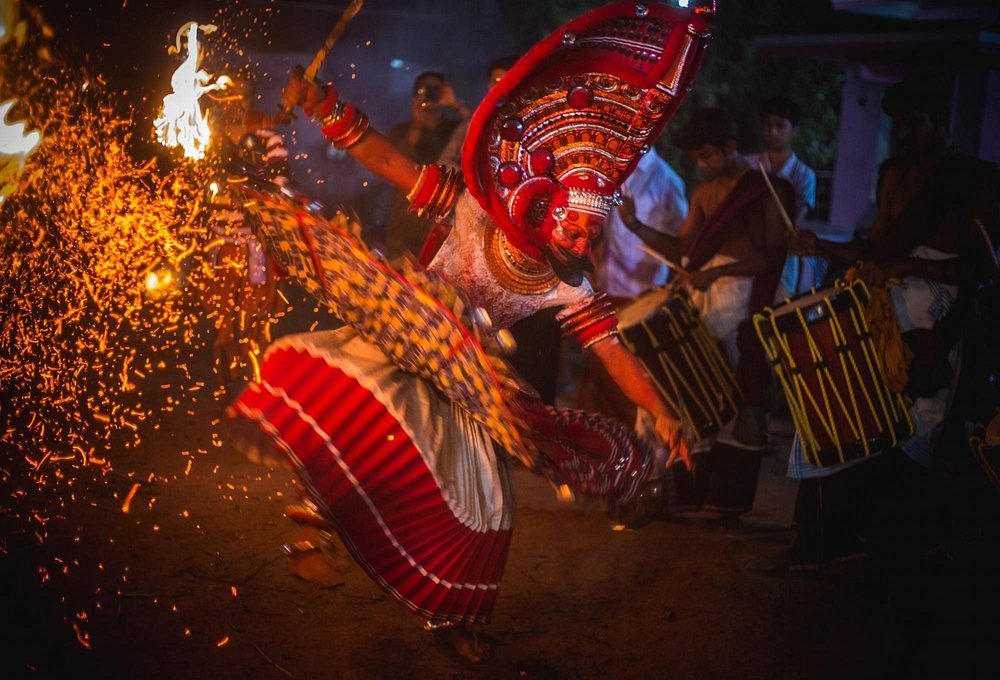
At Gothuruthu, Chavittu Nadakam brings warrior kings to the stage through emphatic footwork, song and elaborate costume. Rooted in Latin Christian coastal communities and shaped by European cultural contact, this theatrical form gives martial imagination a life beyond the battlefield. The armour belongs to performance; the significance lies in the community that continues to practise and sustain it.
Parichamuttukali, a Christian sword-and-shield performance tradition, offers another encounter with martial movement. Kalaripayattu, meanwhile, can be approached through the work of a practising teacher, where balance, timing and bodily discipline matter as much as the weapons on display.
These traditions do not need to be turned into military artefacts to be historically meaningful. Their value lies partly in how communities have carried, reshaped and interpreted them across generations. A theatrical helmet is not evidence of battlefield armour. A modern regimental cry does not automatically establish the words shouted by a medieval army. The distinction between documented history and living interpretation is not a limitation; it is what allows both to be understood honestly.
Kannur: the coast changes hands
End at Kannur, where St Angelo Fort looks out over a harbour and coastline repeatedly drawn into contests for maritime power. Built by the Portuguese in the early sixteenth century, the fort later passed to the Dutch and then the British. The Arakkal house also belongs to the wider history of power along this coast.
Yet Kannur’s maritime history cannot be told through European forts alone. The Arakkal royal house was unusual in the region: its matrilineal succession allowed women as well as men to become rulers. Female heads of the house were known as Arakkal Beevis, while male rulers were known as Ali Rajas. Their authority belonged to a coastal world shaped by trade, diplomacy and relationships with neighbouring rulers and overseas powers. They were not merely witnesses to the contest for the coast, but participants in the political life that grew around it.
Nearby, Burnassery’s cantonment represents a later chapter. The Kannur Cantonment Board records its formal declaration with effect from 1 January 1938, while noting the area’s earlier use as a military camp under Portuguese, Dutch and British rulers. The modern cantonment and the much older fort should not be collapsed into a single historical moment.
Beyond Kannur, the landscape changes again. In Wayanad, the resistance associated with Pazhassi Raja brings forest knowledge and the participation of Kurichiya fighters into the story. Here, the military terrain was not a coastal fort or a parade ground, but a landscape whose paths and forests mattered to those who knew them.
The farther one travels, the harder it becomes to tell the military history of Keralam through kings and commanders alone.
What remains after the army?
A mosque beside a market. A former brigade building now serving a public institution. A defensive line that survives in fragments. A river route once used by armed men. A boat whose form carries memories of a different purpose. A village performance in which warrior kings return, not as historical reconstructions, but as figures sustained by a living community.
These are not interchangeable remnants. Each asks for its own kind of attention, its own evidence and its own understanding of the people who continue to inhabit the landscape.
It is tempting to draw a neat line from military camps to local food, music, dance and craft. Some connections may well emerge through archival records and oral histories. Others may prove to be later associations, or traditions that developed independently of military life. The work is to investigate, not assume.
Keralam’s military past was made by conquest and resistance, trade and diplomacy, shifting alliances and the demands of survival. Its traces are scattered across a region whose present boundaries conceal older political geographies. The forts and battlefields matter, but so do the ordinary places around them: the street that kept its name, the market that continued to trade, the waterway that still carries boats and the community that kept its stories alive.
Perhaps that is the most revealing way to travel through this history. Look beyond the monument. Notice where power met everyday life, where the landscape shaped the course of conflict, and where people made something enduring from the upheavals that passed through their world.
The soldiers may have gone. The landscape remembers differently.